
July 6, 2026
The IPO Hype is Back
Picture this: It’s the summer of 2021, and you’ve just watched the son of your best friend from college get married. You make your way to the cocktail hour to grab a drink before heading to your assigned seat for dinner. After a short wait in line, the bartender hands you your old fashioned, you take a sip and you begin to work your way over to a group of old college friends.
Should investors participate in the latest wave of high-profile IPOs?
As IPO excitement returns with names like SpaceX, OpenAI and Anthropic, many investors wonder if they’re missing out. But IPOs are among the riskiest investments, and today many companies stay private longer, meaning much of their fastest growth may already be behind them. Rather than chasing hype or FOMO, investors should take a long-term view, size any position appropriately within their financial plan and never invest more than they can afford to lose.
You briefly catch up on each other’s families and what has been happening in your lives before the conversation quickly turns to a discussion about whether anyone plans to participate in the Rivian IPO scheduled for later that year.
A few years ago, it seemed like every cocktail party conversation included discussions about the latest hot IPO. Whether it was Facebook (now Meta), Alibaba, or Rivian, the question on everyone’s mind was, “How can I get access to these offerings right as they go public?”
After a quiet stretch of IPO activity over the past few years, a new wave of offerings has begun to emerge this year, along with the same familiar question: “Should I get in on this one?” SpaceX (SPCX) led the way with its public offering on June 12, 2026, followed by Anthropic and OpenAI, which are expected to go public later this year. As IPO activity picks up and headlines grab investors’ attention, many people are once again wondering whether they should participate or if they are missing out on the next big opportunity.
Before jumping into whether participating makes sense, let’s first take a closer look at what an IPO actually is.
An Initial Public Offering (IPO) occurs when a privately held company sells shares to the public for the first time. By becoming publicly traded, the company, and its early investors gain access to a much larger pool of capital, while every day investors gain the opportunity to own a piece of the business.
Historically, IPOs have been viewed as a way to get in early and benefit from a company’s growth potential. The recent reality, however, has been somewhat different. Over the past several years, private funding sources have become much more abundant and accessible. As a result, many companies are staying private longer, and by the time they go public, a significant portion of their fastest growth may already be behind them.
You may be asking yourself, if IPO activity has been relatively quiet for the past few years, why all the excitement now?
First, IPO activity tends to increase during periods of strong stock market performance. Over the past three years, the S&P 500 has delivered impressive returns, gaining 26% in 2023, 25% in 2024, and 18% in 2025. Given that backdrop, it is not surprising to see companies wanting to take advantage of favorable market conditions.
Another reason IPOs are making headlines is the backlog of large, well-known private companies that have announced plans to go public in the near future. The combination of strong markets and highly anticipated offerings creates the perfect recipe for increased investor excitement. Add in a healthy dose of FOMO (fear of missing out), and it is easy to see why so many people are wondering if they should participate.
It’s no secret that every investment involves some level of risk. As the saying goes, with risk comes reward. While all investments carry varying levels of risk, certain investments are inherently riskier than others. IPOs tend to rank near the top of that list.
You could ask 100 different analysts to estimate the future returns of a particular IPO and likely receive 100 different answers, even though they are all working with the same information. The reason is simple, nobody truly knows how the market will value a company once trading begins, and uncertainty often remains long after the IPO date.
Given the added risks associated with IPO investing, you may be wondering, “How do I know if participating is right for me?”
It is important to understand that IPOs are not a tool to get rich overnight. If you ultimately decide to participate, taking a long-term approach is essential. You should also be comfortable with the possibility that the investment could lose money over the period of time in which you hold it.
The chart below shows the one-year returns of 10 well-known companies following their IPOs. As you can see, the short-term results over the first year of trading were less than ideal for all companies.
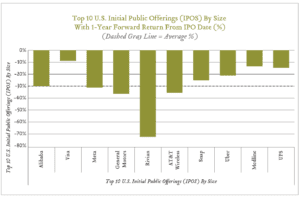
While this chart may look concerning, for some of the companies shown a long-term perspective tells a different story. Investors who remained patient through periods of volatility actually saw positive returns. Since its IPO in 2012, Meta has generated an annualized return of approximately 23%, while Visa, who went public in 2008, has generated an annualized return of roughly 18%. Though, not every long-term picture looks positive. Take Rivian for example. Since going public in 2021, Rivian has produced an annualized return of approximately -36%.
I am not trying to convince you to invest in, or avoid investing in, the next highly anticipated IPO. The reality is that it is difficult to predict what will happen with companies like SpaceX, OpenAI, or Anthropic. Could they all be winners? Possibly. Could they all disappoint investors? That’s possible too.
Before taking investment advice from a friend at the next cocktail party, it is important to understand the elevated risks involved with IPO investing. If you choose to participate, make sure your investment is sized appropriately within your overall financial plan and that you are not investing more than you can comfortably afford to lose.