
November 6, 2026
Private Markets Coming to the 401(k)
You may have seen the headlines: private equity, private credit and real estate funds are heading into 401(k) plans. For business owners and executives, the natural questions are practical ones. Does this change my company’s plan? Does it change my own retirement picture? For most of our clients, the honest answer is that very little will change on your plan menu. But there is one place participants across the country could see a change without ever choosing it, the plan’s Target Date Fund, and the conversation is a useful prompt to review how your retirement plan and your broader wealth fit together.
What Actually Happened
In August 2025, an executive order directed the Department of Labor (DOL) to make it easier for 401(k) plans to offer “alternative assets.” The DOL then withdrew its earlier guidance that had discouraged private equity in plan menus. In March 2026, it proposed a rule that would give plan fiduciaries a safe harbor, a presumption of prudence, if they follow a defined process when selecting investments. As of mid-October, that rule has not been finalized and could still change.
What has not changed is the underlying law. The fiduciary standard has always been about process: acting with the care and diligence of a prudent expert. Nothing ever prohibited private assets in a plan. In fact, there are some publicly traded mutual funds held by retirement plans that already have private alternative “sleeves.” The new guidance simply lowers the temperature around offering private alternatives within public investment vehicles that could be considered within a retirement plan investment menu.
Why the Private Alternative Industry is Knocking: The Size of the Prize
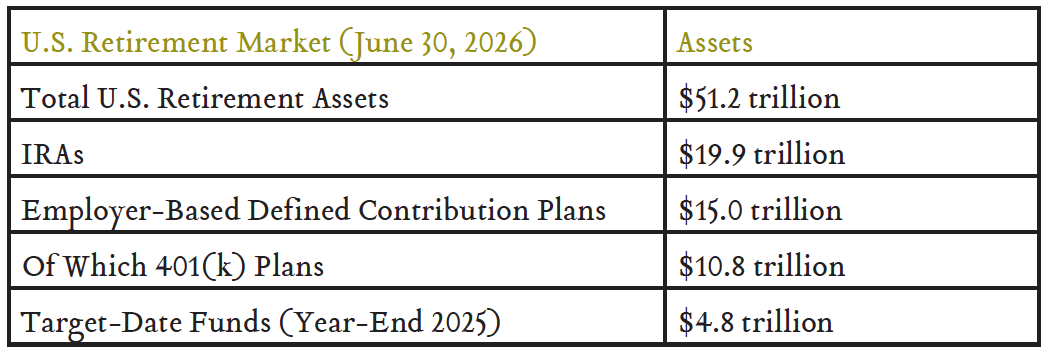
To understand the push, start with the numbers. Americans held $51.2 trillion in retirement assets at the end of June 2026, about a third of all household financial assets. Employer-based defined contribution plans account for $15.0 trillion of that, and 401(k) plans alone hold $10.8 trillion. Roughly 85 million Americans rely on these plans to save for retirement.
For private market managers, that is an enormous and steady pool of capital that has been largely out of reach. Traditional pension plans have long invested in private markets, with allocations that BlackRock puts at roughly 16% on average, while 401(k) participants have had little access. Employer plans also deliver something private fund sponsors prize: regular payroll contributions that arrive every pay period and are often invested automatically. Proponents argue that giving everyday savers the same tools that pensions have used could improve retirement outcomes. That argument may have merit. But it is also fair to remember that the firms making it have a commercial interest in gaining access to the largest pool of long-term savings in the country.
The problem is that private investments sit awkwardly inside a 401(k). Participants expect daily pricing and daily access to their money; private assets are valued infrequently and are hard to sell quickly. The funds that bridge the gap, such as interval funds that repurchase shares quarterly, add cost and complexity. Fees are typically higher than those of the public funds they would sit beside, and results depend heavily on the skill of the manager chosen.
For a small or mid-sized company, the cost of due diligence, monitoring, and participant education is rarely justified by a modest allocation. Litigation adds to the caution: the Supreme Court recently made it easier for fiduciary claims to survive early dismissal, and it heard another 401(k) case this month on how investment underperformance must be pleaded. The conclusion is simple– having large private investment exposure inside a single investment option poses more fiduciary threats than performance advantages.
Where Private Markets are Most Likely to Show Up First: Your Target Date Fund (TDF)
If a standalone private fund on the investment menu is an awkward fit, a different approach solves much of the liquidity problem, and it is the one most likely to reach your plan. Instead of asking participants to choose a private fund, the manager of a TDF can place a limited private markets sleeve inside the portfolio. The rest of the fund stays in daily-traded stocks and bonds, which provide the cash needed to meet everyday withdrawals and transfers. Participants still buy and sell one fund at one daily price, and the investment team, not the participant, decides how much of the portfolio sits in private assets and manages it as a single portfolio.
Several factors make target-date funds the most natural entry point:
- Scale. Target-date funds reached $4.8 trillion at the end of 2025, up more than 20% in a year. Each 1% of those assets allocated to private markets would equal roughly $48 billion.
- Concentration. Five firms hold about 80% of target-date assets, and one holds about 37%. A handful of decisions by large providers can change what millions of participants own.
- Default status. Target-date funds are the default investment in an estimated 86% of plans, so assets flow in automatically through enrollment and payroll.
A private alternatives sleeve inside TDF’s is not a cure-all. Private assets in the mix still carry higher fees, valuation that relies on estimates rather than daily market prices, and a wide gap between strong and weak managers. They also introduce questions about how the fund is priced for participants who buy or sell on different days. Providers will answer these questions differently, and some of the largest target-date firms may choose to wait, so the offerings will vary.
For high net worth individuals, the more important question is not whether private markets belong in the company 401(k). It is where they belong in your total balance sheet. Your retirement plan is one account among many, and it is the least flexible place to hold an illiquid investment. Outside the plan, access to private funds can be matched to your liquidity needs, your risk tolerance, your tax situation, and your estate plan, and it can be sized against everything else you own, including potential private business interests. Many of our clients already hold significant illiquid wealth through a privately held company, so adding more illiquidity inside a retirement account, including through a TDF, may increase concentration rather than diversification.
Private markets can play a role in a well-built portfolio, but the benefits depend on manager selection, and the spread between strong and weak managers is wide. Fees, liquidity limits, and valuation methods deserve the same scrutiny you would give any significant investment.
All that said, the door to private markets in the 401(k) is opening, and TDFs are the likeliest place to see it take hold at scale. The plans and investors who benefit will be those who decide deliberately, whatever the final rule says.