March 6, 2026
January Retail Sales - Wheels and Weather in Focus
A delayed report showed retail sales softened somewhat in January primarily reflecting declining outlays in the auto sector as well as weather-related disruptions. In nominal terms retail spending was up 3.2% year-over-year but down 0.2% compared to December. Adjusting for inflation, spending rose 0.6% year-over-year and declined 0.4% month-over-month. While a lengthy winter storm that included significant snowfall and ice across the central and eastern U.S. likely impeded shoppers, concerns over the job market and cost of living appear to be driving more modest spending at the turn of the year. At our year-end seminars, we discussed the concept of a K-shaped economy where some parts of the economy are doing well and other parts of the economy are not doing so well (trending higher and lower in the shape of a K). Today’s data may be indicative of the stress being applied to lower-income earners who get their confidence and willingness to spend from a healthy labor market and gainful employment. Higher income earners who represent a smaller percentage of the population but account for the lion’s share of spending are more influenced by the health of financial markets and portfolio wealth.
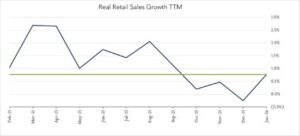
- Real (inflation adjusted) retail sales rose 0.6% year-over-year. In January, retail sales grew 3.2% nominally netting real growth of 0.6% after adjusting for 2.4% inflation. Higher spending at online (+10.9%) and brick-and-mortar retailers (+10.8%) was partially offset by slower spending on motor vehicles (+0.1%) and declines at the pump (-3.9%). Seven of thirteen categories advanced in real terms.
- Real (inflation adjusted) retail sales declined 0.4% month-over-month. In January, nominal retail sales levels fell 0.2% compared to December netting a real decline of 0.4% after adjusting for 0.2% inflation. Stronger spending at brick-and-mortar (+2.0%) and online retailers (+1.9%) as well as building materials (+0.6%) was offset by a slowdown on motor vehicles (-0.9%) and gasoline (-2.9%). Five of thirteen categories advanced in real terms.